How to Understand FRM Exam Results: Quartiles, Percentiles & Next Steps
Confused by your FRM result report? Learn how to interpret GARP's pass/fail result, topic quartiles, percentile bands, and what to do next after passing or failing.
FRM result day can be surprisingly confusing.
You expect a clear score. Instead, you usually see a simple pass/fail result and a separate performance analysis showing how you did across broad topic areas. Many candidates then start asking the same questions:
- What do the quartiles mean?
- Is “1st quartile” good or bad?
- Can I estimate my real score?
- Why did someone pass with similar quartiles while someone else failed?
- What should I do next?
This guide explains how to read your FRM result report without overinterpreting it.
Important: This article is an educational guide from FRM Prep Lab. Your official result is the one shown in your GARP candidate portal. FRM®, GARP®, and Financial Risk Manager® are trademarks of the Global Association of Risk Professionals, Inc. This article is not affiliated with or endorsed by GARP.
Last verified: 25 June 2026
The short version
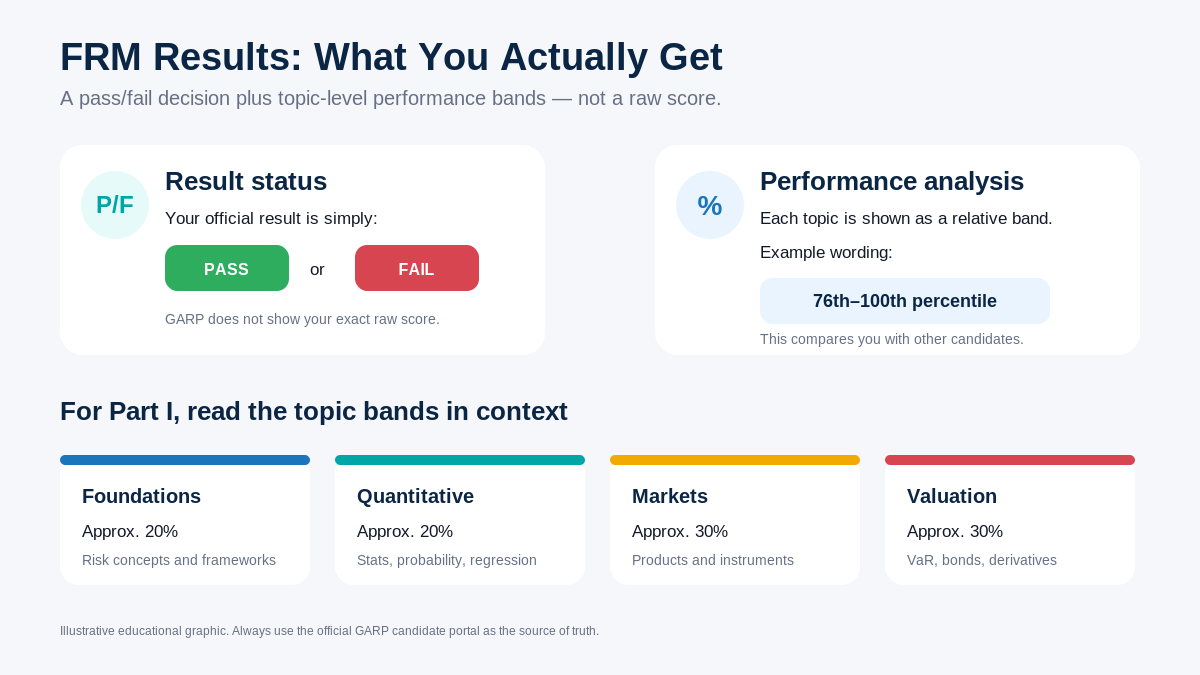
Your FRM exam result has two main parts:
- Your official pass/fail decision. This is what matters for progression.
- Your topic-level performance analysis. This helps you understand relative strengths and weaknesses, but it is not a raw score.
GARP states that both FRM exams are scored on a pass/fail basis, with results accessible through the GARP candidate portal within eight weeks of the exam window closing. Candidates also receive quartile results comparing their topic performance with other candidates.
So the key point is simple: quartiles explain your performance profile, but they do not replace the official pass/fail result.
What does GARP actually give you?
GARP does not normally give candidates a full mark such as “68/100” or “72%.” Instead, your result information is usually split into:
1. The official result letter
This tells you whether you passed or failed.
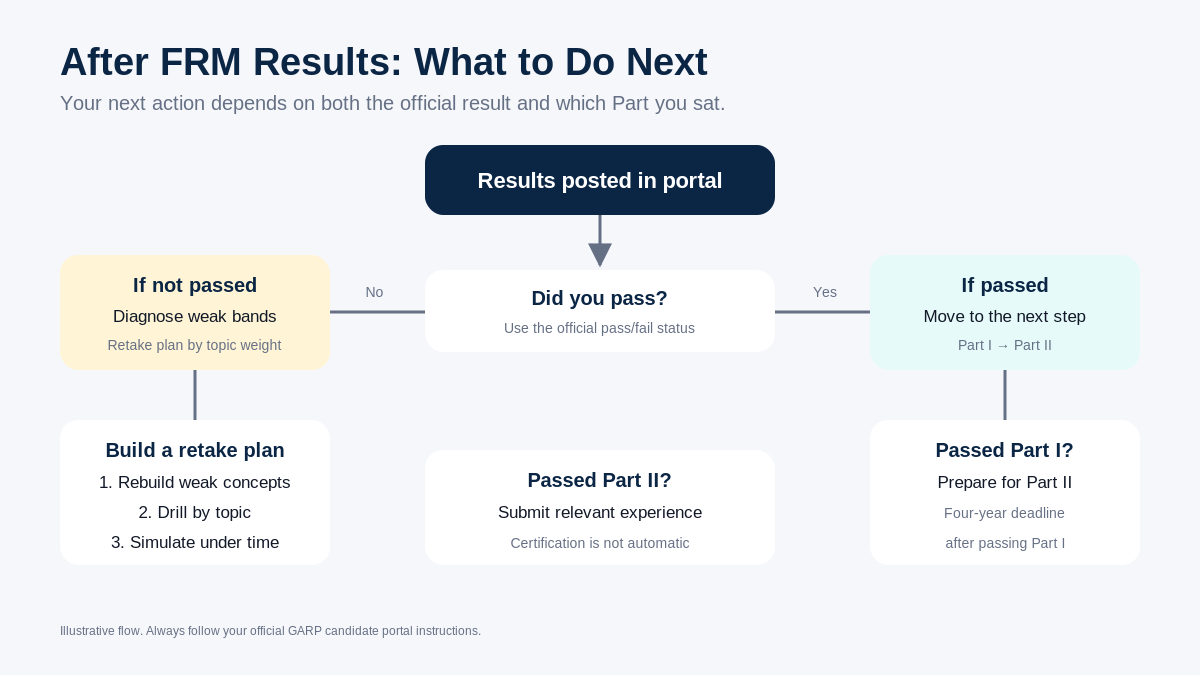
For FRM Part I, passing means you can move on to FRM Part II. For FRM Part II, passing means you can move on to the work-experience step of the certification process.
2. The performance analysis
This breaks your performance into topic areas and shows how you performed relative to other candidates.
Depending on the report format, candidates may see wording like:
- “1st quartile,” “2nd quartile,” etc.
- “76th–100th percentile range,” “51st–75th percentile range,” etc.
- descriptive labels such as excellent, good, fair, or poor understanding.
The wording may vary across result PDFs and years, but the concept is the same: the report is giving you a performance band, not your exact score.
What do FRM quartiles mean?
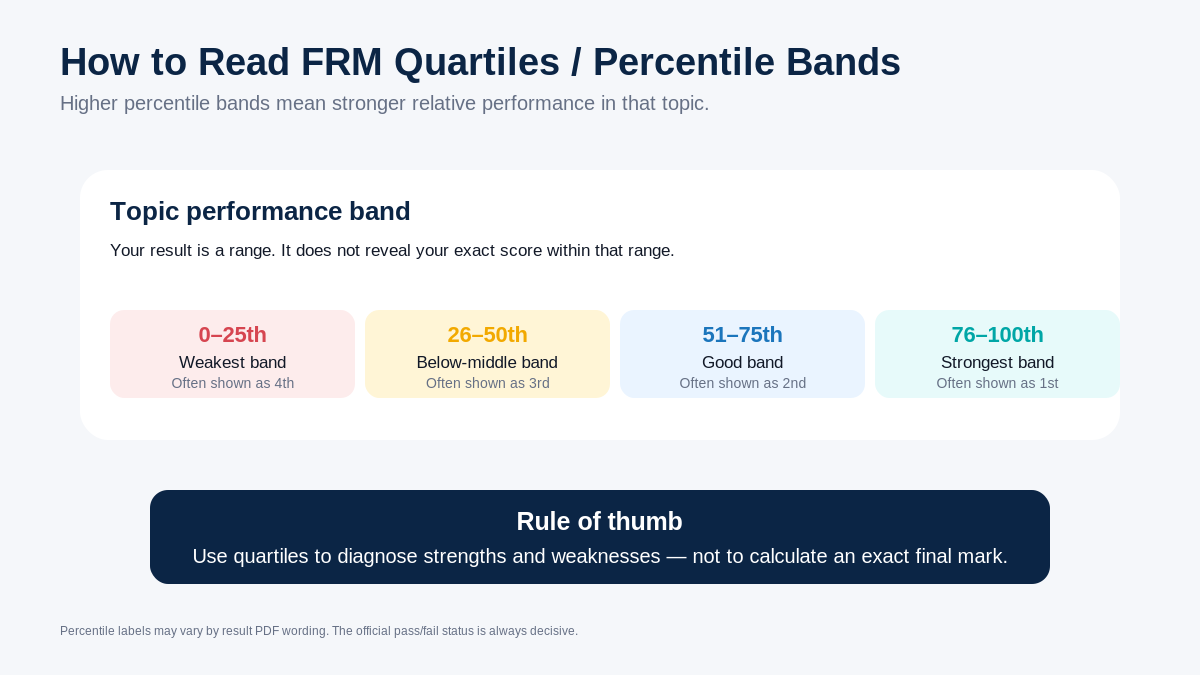
A quartile divides a distribution into four broad groups. In FRM result discussions, the usual interpretation is:
| Result band | Practical meaning | How to read it |
|---|---|---|
| 76th–100th percentile / 1st quartile | Strongest band | You performed better than most candidates in that topic. |
| 51st–75th percentile / 2nd quartile | Good band | You were above the middle of candidates in that topic. |
| 26th–50th percentile / 3rd quartile | Below-middle band | This topic may need work, especially if heavily weighted. |
| 0–25th percentile / 4th quartile | Weakest band | This was likely a significant weakness. |
The confusing part is that “1st quartile” is good in the older FRM result convention. Candidates sometimes assume “1st” means the lowest group, but FRM result screenshots and candidate discussions typically use 1st quartile to mean the top band.
A safer way to think about it is this:
Higher percentile range = better. Lower percentile range = weaker.
Can you calculate your exact FRM score from quartiles?
No — not reliably.
Quartiles are wide ranges. A candidate near the top of the 51st–75th percentile band and a candidate near the bottom of the same band may look identical in the report, even though their actual performance could be materially different.
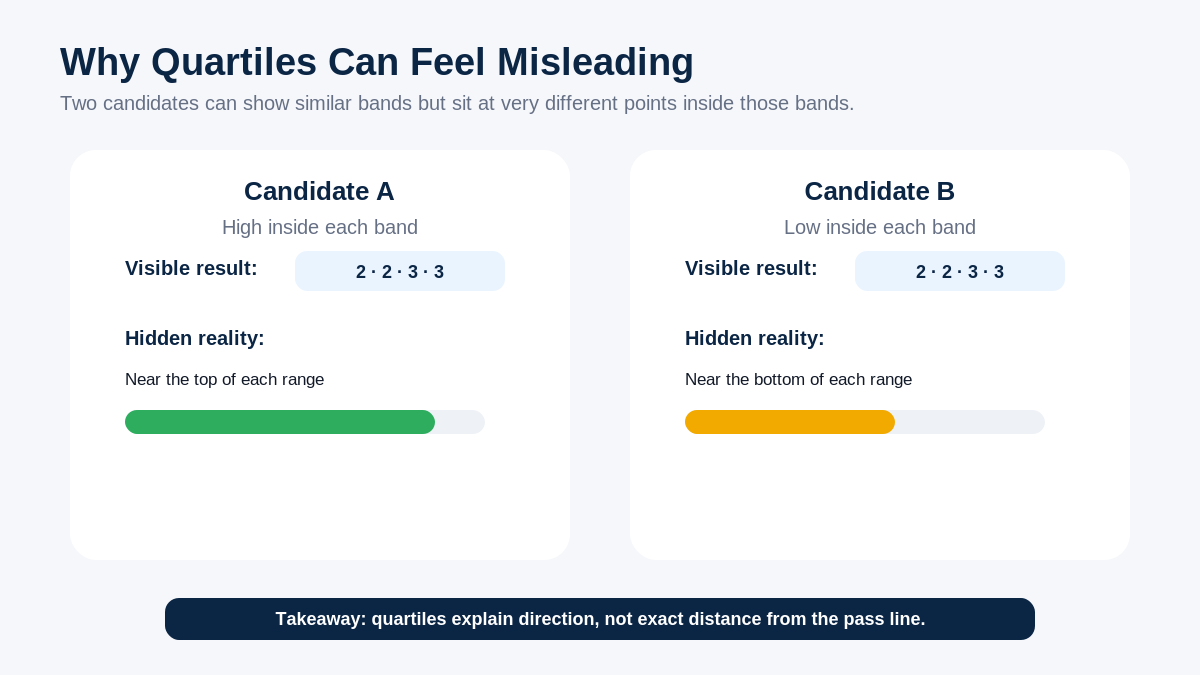
That is why two candidates can report similar quartile patterns online but have different pass/fail outcomes. Several things can be happening at once:
- each quartile covers a broad range;
- candidates can sit near the top or bottom of the same band;
- topics have different weights;
- the pass/fail decision is based on the full scoring process, not on the simplified quartile display.
Third-party providers often publish estimated minimum passing score ranges, but those are estimates. Treat them as rough study benchmarks, not as official GARP cutoffs.
Why topic weights matter, especially for FRM Part I
For FRM Part I, the exam has four major topic areas:
- Foundations of Risk Management
- Quantitative Analysis
- Financial Markets and Products
- Valuation and Risk Models
GARP describes FRM Part I as a 100-question, equally weighted multiple-choice exam administered by computer-based testing. The individual questions are equally weighted, but the curriculum domains have approximate topic weightings. Kaplan’s FRM Part I syllabus overview, referencing GARP, lists the approximate Part I weights as 20%, 20%, 30%, and 30%.
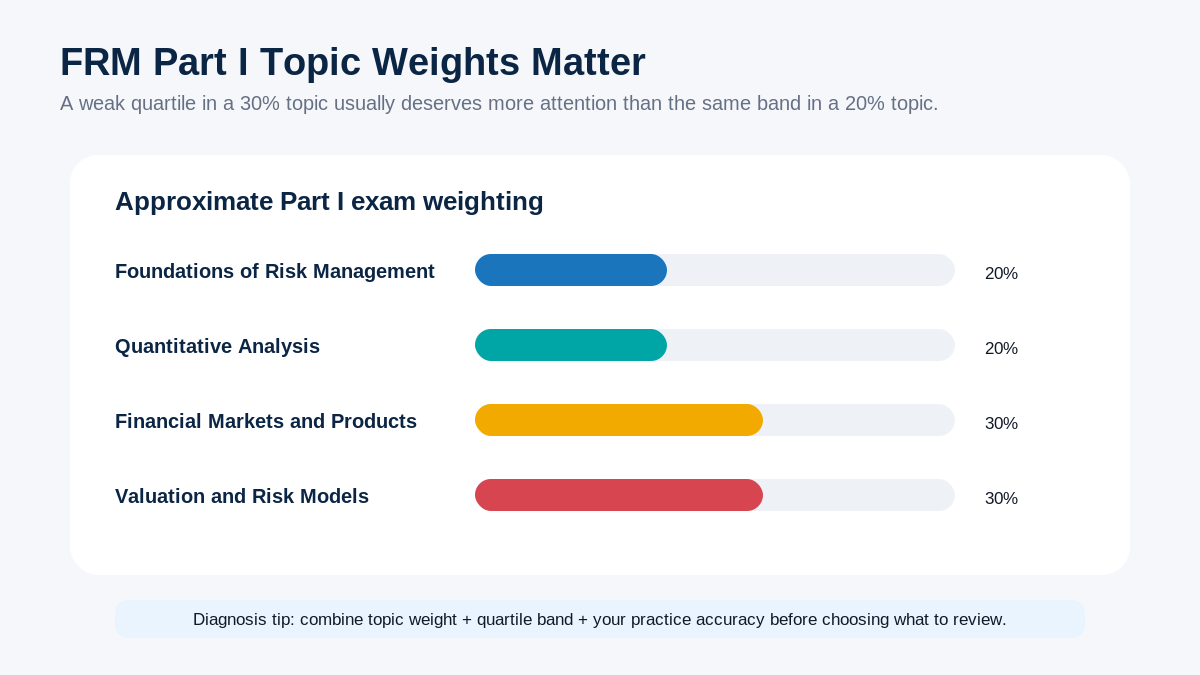
That means a weak band in Financial Markets and Products or Valuation and Risk Models may matter more than the same weak band in a smaller topic, because those two areas together represent a larger share of the Part I exam.
Use this hierarchy when diagnosing your result:
- Start with the official pass/fail decision.
- Look at your weakest percentile bands.
- Prioritize weak bands in higher-weight topics.
- Compare the result with your FRM Part I practice question accuracy.
- Build your next study plan around question practice, not passive rereading. See our FRM Part I study plan for a practical weekly structure.
Examples: how to interpret common FRM Part I result patterns
Example 1: Strong pass profile
Possible pattern: 1 / 1 / 2 / 1 or 76–100 / 76–100 / 51–75 / 76–100
This suggests strong topic coverage. If you passed Part I, you should not spend too much time trying to reverse-engineer the exact score. Move on to Part II planning.
Example 2: Passed, but with one weak topic
Possible pattern: 1 / 2 / 3 / 1
This can happen. One weaker topic does not necessarily prevent a pass if your overall performance is strong enough elsewhere, especially in higher-weight areas. But the weak topic still matters: FRM Part II often assumes you understand the Part I toolkit.
Example 3: Failed with mixed quartiles
Possible pattern: 2 / 3 / 3 / 2 or 3 / 2 / 3 / 3
This usually means the candidate was not far from being competitive, but too many topics were around or below the middle of the candidate pool. The best response is not to restart from zero. Instead, rebuild weak topics and increase exam-style practice volume.
Example 4: Failed with one very weak high-weight topic
Possible pattern: 1 / 2 / 4 / 2 or 2 / 2 / 3 / 4
This is where topic weighting matters. A very weak result in Financial Markets and Products or Valuation and Risk Models can be expensive because those areas are larger in Part I.
If you passed FRM Part I
First: congratulations. Do not waste the next two weeks trying to estimate your exact score.
Your next job is to plan FRM Part II.
GARP states that candidates have four years from the date they pass Part I to take and pass Part II. That sounds like a long time, but it is better to decide early whether you want to sit the next available window or give yourself a longer runway.
Your Part I quartiles can still help. They show which foundational tools may need refreshing before Part II:
- weak Quantitative Analysis → review regression, distributions, hypothesis testing, and simulation;
- weak Financial Markets and Products → review derivatives, fixed income, and market instruments;
- weak Valuation and Risk Models → review VaR, volatility, bond valuation, and option risk measures.
If you failed FRM Part I
A failed result is frustrating, but the quartiles can be useful if you use them correctly.
Do not read the report as a personal judgment. Read it as a diagnostic tool.
Use this retake framework:
- Identify the weakest bands. Start with 4th quartile / 0–25th percentile topics.
- Overlay topic weight. Prioritize weak high-weight topics first.
- Separate knowledge gaps from exam-speed gaps. Did you fail because you did not know the material, or because you could not apply it quickly enough?
- Use active practice. More reading alone rarely fixes FRM performance. You need topic quizzes, mixed quizzes, and timed mock-style practice.
- Track accuracy by topic. Your goal is not to “feel better” about a chapter. Your goal is to see accuracy improve under exam-like conditions.
A practical retake plan might look like this:
| Phase | Focus | What to do |
|---|---|---|
| Week 1 | Diagnosis | Map quartiles to topics, review mistakes, identify weak subtopics. |
| Weeks 2–5 | Rebuild | Study weak areas and do targeted question drills. |
| Weeks 6–8 | Integration | Mix topics, increase question volume, review explanations deeply. |
| Final weeks | Exam simulation | Timed mocks, formula recall, error log, final review. |
If you passed FRM Part II
Passing Part II does not automatically make you fully certified.
To earn the FRM certification, candidates must pass both parts and submit relevant full-time financial risk management work experience. GARP describes relevant experience as work where identifying, measuring, monitoring, or managing risk is a meaningful part of the role.
After passing Part II, the next step is to submit your work experience through your GARP account. GARP’s FAQ says candidates have 10 years from the date they pass Part II to submit professional experience, or they may need to retake the exams and re-enroll.
If you sat Part I and Part II in the same administration
This is important: GARP says that if candidates sit for Part I and Part II in the same administration but fail or do not show up for Part I, their Part II exam will not be graded.
So if you took both, read your Part I result first. Part II only matters if Part I was passed.
Common mistakes when reading FRM results
Mistake 1: Treating quartiles as exact scores
A quartile is a range. It is not the same as your raw mark.
Mistake 2: Comparing yourself too literally with Reddit or WhatsApp groups
Candidate result threads can be useful emotionally, but they are not a scoring model. Two candidates can show similar visible bands but have different hidden performance inside the bands. For context on unofficial early-result checks, see our guide to the FRM results Apex method.
Mistake 3: Ignoring topic weights
A weak band in a larger topic can be more damaging than a weak band in a smaller topic.
Mistake 4: Assuming one weak topic always means failure
It does not. The final outcome depends on the full scoring process.
Mistake 5: Restarting the whole curriculum after a fail
Most retakers do not need to restart from zero. They need a sharper plan: weak topics, question practice, timing, and error review.
How to turn your quartiles into a study plan
Use this simple diagnostic table.
| Your result | Meaning | Action |
|---|---|---|
| 76th–100th / 1st quartile | Strong area | Maintain with light review and mixed questions. |
| 51st–75th / 2nd quartile | Good but not bulletproof | Keep practicing, especially if high-weight. |
| 26th–50th / 3rd quartile | Risk area | Rebuild concepts and drill targeted questions. |
| 0–25th / 4th quartile | Major weakness | Prioritize immediately, especially if high-weight. |
For FRM Part I retakers, a good study tool should let you practice by topic, review explanations, and track accuracy over time. That is exactly the kind of workflow FRM Prep Lab is designed for: start with a weak topic, generate a quiz, review explanations, and watch whether your accuracy improves.
Turn your weak quartiles into targeted practice. Try a free FRM Part I quiz on FRM Prep Lab. For full access to the question bank and progress tracking, see what’s included in Full Access.
FAQ
Is 1st quartile good in FRM results?
Yes, in the common FRM result convention, 1st quartile usually refers to the strongest band. Newer result wording may show percentile ranges instead. If your report says 76th–100th percentile, that is the strongest range.
Does GARP publish the FRM passing score?
GARP publishes pass rates and pass/fail results, but it does not normally disclose each candidate’s raw score or a fixed public minimum passing score. Third-party estimates exist, but they should not be treated as official cutoffs.
Can I pass with a 3rd quartile in one topic?
Yes, it is possible. One weaker topic does not automatically mean failure. The overall result depends on the full scoring process, your performance within each band, and topic weighting.
Can two candidates have the same quartiles but different pass/fail results?
Yes. Quartiles are broad ranges. Two candidates can appear similar in the simplified report but be at different points inside those ranges.
What should I do after failing FRM Part I?
Use your performance analysis as a diagnostic. Prioritize weak high-weight topics, drill exam-style questions, track accuracy by topic, and take timed mixed quizzes before the next sitting.
What should I do after passing FRM Part I?
Start planning FRM Part II. You do not need to know your exact Part I score. Use your quartiles only to identify Part I topics that may need refresh before Part II.
Final takeaway
Your FRM result report is not designed to tell you exactly how many questions you got right. It is designed to tell you whether you passed and to give you a rough map of your relative strengths and weaknesses.
So read it in this order:
- Pass/fail first.
- Quartiles second.
- Topic weights third.
- Study plan last.
If you passed, move forward. If you failed, use the data. Your quartiles do not define you — but they can tell you exactly where to start.
Practice by topic, review explanations, and track your progress with FRM Prep Lab.
Source notes
GARP, “FRM Program and Exams.” GARP states that FRM Part I has 100 equally weighted questions, Part II has 80 equally weighted questions, both exams are four hours, exam windows are offered in May, August, and November, results are pass/fail, results are available through the candidate portal within eight weeks of the exam window closing, and candidates receive quartile results comparing performance with other candidates. Source checked 2026-06-25: garp.org/frm/program-exams
GARP, “FRM FAQs.” GARP describes FRM Part I as an equally weighted 100-question multiple-choice computer-based exam and Part II as an equally weighted 80-question multiple-choice computer-based exam. Source checked 2026-06-25: garp.org/frm/frequently-asked-questions
GARP, “FRM FAQs.” GARP explains that candidates are notified when results are available in the GARP candidate portal and that Part II is not graded if a candidate sat both parts but failed or did not show for Part I. Source checked 2026-06-25: garp.org/frm/frequently-asked-questions
GARP, “FRM FAQs.” GARP describes relevant financial risk management work experience as work where identifying, measuring, monitoring, or managing risk is a meaningful part of the role. Source checked 2026-06-25: garp.org/frm/frequently-asked-questions
GARP, “FRM FAQs.” GARP states that candidates have 10 years from passing Part II to submit professional experience. Source checked 2026-06-25: garp.org/frm/frequently-asked-questions
Kaplan UK, “FRM Part 1.” Kaplan’s syllabus overview lists the approximate FRM Part I topic weights as Foundations 20%, Quantitative Analysis 20%, Financial Markets and Products 30%, and Valuation and Risk Models 30%, and refers readers to GARP for more information. Source checked 2026-06-25: kaplan.co.uk/courses/frm/part-1
300Hours, “FRM Minimum Passing Score: Our Best Estimates So Far.” 300Hours notes that GARP does not release FRM minimum passing scores and that third-party estimates should be treated as estimates. Source checked 2026-06-25: 300hours.com/frm-minimum-passing-score
Preparing for FRM Part I?
Use FRM Prep Lab to practice exam-style questions, review detailed explanations, and build confidence before exam day.
FRM question bank Clear explanations Progress tracking Exam simulation
Related resources
FRM Exam
FRM Results Apex Method: How Candidates Try to Check GARP Results Early
Some FRM candidates use the “Apex method” to check whether GARP results or quartiles are visible before the official email arrives. Here is how it works, what to look for, and why you should treat it carefully.
Comparisons
FRM Prep Lab vs AnalystPrep: Which Is Better for FRM Part I?
Compare FRM Prep Lab and AnalystPrep for FRM Part I—practice-focused quizzes and mocks versus a fuller course with notes, videos, and higher-priced packages.
Comparisons
FRM Prep Lab vs Bionic Turtle: Which Is Better for FRM Part I?
Compare FRM Prep Lab and Bionic Turtle for FRM Part I—focused question practice and timed mocks versus a broader course with notes, videos, spreadsheets, and live review.